James Hardie Junior ADU Conversion: The Fort Worth Owner’s Guide
If you’re converting a detached garage or building a junior accessory dwelling unit (JADU) in Fort Worth and your James Hardie siding, trim, or HardieBacker substrate is failing at the connection points, we stock and install the full range of James Hardie-compatible replacement materials, and typical installed pricing for a JADU conversion envelope repair runs $2,800 to $9,500 depending on how much of the cladding and waterproofing has to come off. Most Fort Worth owners discover the problem after a heavy spring storm, when they notice peeling paint at the bottom edge of the HardiePlank lap siding, soft spots around window penetrations, or crumbling HardieBacker behind a JADU bathroom wall. The issue is rarely the James Hardie product itself, it’s almost always improper flashing, missing weep screeds, or fasteners that were overdriven during the original install, and those failures let Texas rain get behind the cladding where it quietly rots the framing.
Here’s the short version for Fort Worth homeowners: a JADU conversion means you’re turning part of an existing home or attached garage into a self-contained living unit under 500 square feet with its own entrance, kitchenette, and bath. James Hardie materials are the gold standard for that envelope, but only if they’re installed to the manufacturer’s spec. When they’re not, you get the exact failures we see on job sites across this city every spring.
Which James Hardie Models This Applies To
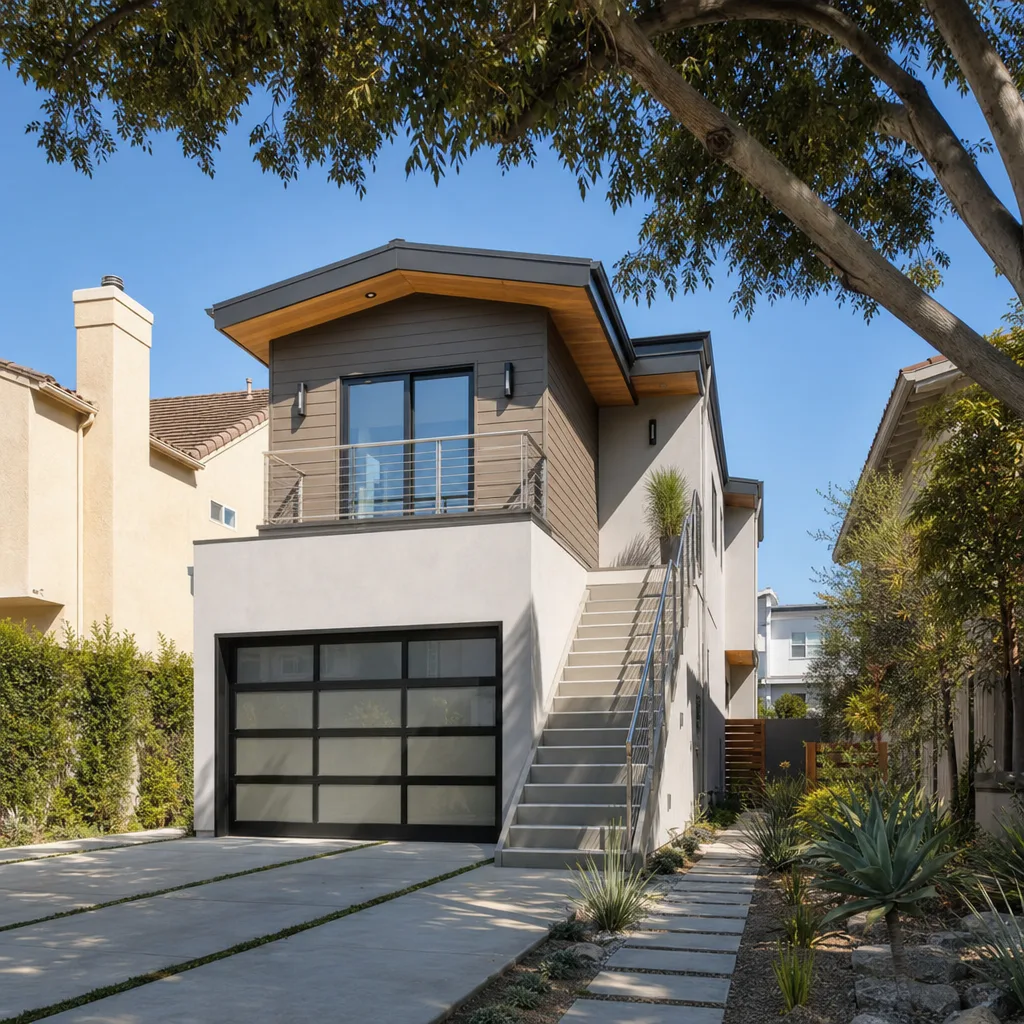
We work with the full James Hardie cladding and substrate lineup on Fort Worth JADU conversions: HardiePlank lap siding (5/16″ and 7/16″ thicknesses), HardiePanel vertical siding, HardieTrim boards (4/4 and 5/4), HardieSoffit panels, and HardieBacker cement board in 1/4″ and 1/2″ for wet-area tile substrate. The compatibility gotcha most owners run into is mixing thicknesses mid-wall. If your original JADU exterior used 5/16″ HardiePlank and a partial repair was done with 7/16″ stock, the lap lines will never align and the butt joints will telegraph through the paint. We see this constantly on Fort Worth garage conversions where a previous handyman “patched” a few courses.
Identifying your exact product is straightforward: pull a loose piece from an inconspicuous area and look at the back face. James Hardie stamps the product name and manufacturing code directly into the board. HardiePlank carries an embossed cedar-grain texture on the front with a smooth back; HardiePanel is smooth or stucco-textured; HardieTrim has a smooth finish with square or beaded edges. If you don’t want to pull a board, measure the exposed face: 5/16″ plank exposes 6-7/8″ per course, 7/16″ exposes 6-3/4″. That difference is the tell.
For JADU work specifically, one checkable spec that matters in Fort Worth: James Hardie requires a 6″ clearance between the bottom edge of siding and grade, plus a properly installed weep screed or kickout flashing at all roof-to-wall intersections. Skip either and you’re inviting the exact water intrusion failures that send Fort Worth owners looking for replacement parts in the first place.
Signs Your James Hardie Junior ADU Conversion Is Failing
- Peeling or bubbling paint at the bottom 6 inches of siding: This means water is wicking up from grade contact or sprinkler overspray. The fix isn’t more paint; it’s correcting the clearance gap and replacing the damaged courses with properly flashed HardiePlank.
- Soft spots or discoloration around window and door trim: Failed head flashing above the opening lets water run behind the HardieTrim, saturating the building wrap and eventually the framing. In Fort Worth’s clay soil, foundation movement makes these gaps worse over time, opening joint fractures that let water in.
- Cracked or crumbling HardieBacker in the JADU bathroom: This usually traces to incorrect fastener spacing or missing alkali-resistant mesh tape at board seams. Once water gets behind the tile, the board wicks moisture and loses structural integrity.
- Visible nail heads or fastener pops along siding courses: Overdriven nails break the siding’s structural fibers. The James Hardie specification is specific: fasteners should sit flush, never countersunk, spaced no more than 16″ on center into studs. When installers bury the nail, the board eventually cracks at the fastener and the panel loses its wind-load rating.
- Rust staining running down from siding fasteners: Someone used electroplated steel nails instead of hot-dipped galvanized or stainless. The fastener corrodes, the staining migrates into the paint film, and eventually the nail head fails entirely, leaving the siding loose in a Fort Worth windstorm.
Replacement Cost & What’s Included
In Fort Worth, expect these installed price ranges for James Hardie JADU conversion repairs and replacement work:
- Partial HardiePlank siding repair (single wall, up to 100 sq ft): $1,800 to $3,400
- Full JADU exterior re-cladding (400 to 500 sq ft total wall area): $6,500 to $9,500
- HardieBacker bathroom replacement (one JADU bath, walls only): $900 to $2,100
- Flashing, weep screed, and trim correction around existing siding: $450 to $1,200
- Fascia and soffit replacement with HardieTrim and HardieSoffit: $1,400 to $2,800
Every one of those numbers includes parts, labor, debris removal, and the flashing or substrate corrections needed so the replacement doesn’t fail the same way the original did. You get a written price before we touch anything, and every James Hardie replacement we install on a Fort Worth JADU conversion is covered by our 365-Day Done Right Promise. If a seam opens or a fastener fails within a year, we’re back to fix it at no charge.
DIY or Call Us?
You can safely handle a few diagnostic tasks yourself: check the clearance between your siding bottom edge and the soil (should be 6 inches minimum), look for sprinkler heads spraying directly onto the wall, and pull a few visible fasteners to check for rust. Those are read-only inspections that will tell you a lot about what’s going on behind the cladding. What you shouldn’t do is start pulling courses of HardiePlank or cutting into HardieBacker around a JADU wet wall. Cement board contains silica dust that requires proper respiratory protection, and once you open the envelope of an accessory dwelling unit, you’ve exposed the flashing sequence, which has to go back in the right order or you’ve created a new leak path. If the damage extends past the first course of siding, the repair almost always involves reflashing, and that’s when we say call us. We’ll come out, put the problem in writing, and quote you a number for the fix. Reach us at (682) 204-9686.
One other Tex-as-specific reality: Fort Worth sees every kind of weather in a single week, and James Hardie materials are engineered for exactly that. The failure we’re chasing is rarely the fiber cement itself. It’s the connection details around it. That’s where the real repair work lives.
Troy Eastman, our owner and lead builder, has been building and repairing accessory dwelling units in Fort Worth for years, and he’s torn open enough failed JADU envelopes to know that ninety percent of the damage traces to three mistakes overdriven fasteners, missing head flashing, and grade clearance that got buried by landscape work. If it’s not in writing, it’s not a promise, it’s just a conversation. That’s how we run every James Hardie parts and repair job we take on in Fort Worth.
FAQs
James Hardie siding and trim carry a 30-year limited transferable product warranty, and in Fort Worth’s climate the material itself will typically outlast that. What fails first is always the installation details: flashing, fasteners, and clearance. A properly installed HardiePlank JADU exterior should need only paint and caulk maintenance for 15 to 20 years before any boards need replacement. Call (682) 204-9686 if you suspect your installation wasn’t done right, and we’ll assess it for free.
Yes, if the damage is contained to a few courses and the underlying framing is dry and intact. We can cut out the damaged boards, install new flashing where needed, and splice in matching HardiePlank so the repair blends after paint. Once framing is water-damaged, you’re past the patch stage and into full replacement. We’ll tell you honestly which one you’re looking at, call (682) 204-9686 for a straight answer.
Most partial siding or trim replacements take one to two working days. A full re-cladding of a JADU exterior runs three to five days. HardieBacker bathroom work usually stays inside one or two days. We give you the schedule in writing before we start, and you’ll get a live arrival time on the day of the work, not a four-hour window.
We stock the most common Fort Worth repair items at all times: HardiePlank 5/16″ and 7/16″ lap siding, HardieTrim in standard profiles, HardieBacker in 1/4″ and 1/2″, plus the correct hot-dipped galvanized and stainless fasteners, flashing tape, and weep screed materials that have to go in with them. We also work with the other major prefab and materials brands including Abodu, Cover, and Dvele, so if your JADU shell came from a prefab system, we can source the right interface materials to match.
Get Your Fort Worth James Hardie JADU Conversion Priced
If your junior ADU conversion has failing siding, trim, or substrate, don’t wait for the next Fort Worth downpour to find the leak for you. Call (682) 204-9686 and we’ll schedule a free assessment, put the diagnosis in writing, and give you a firm price before any work begins. That’s the only way we do business in Fort Worth.
Written by Troy Eastman, Owner & Lead Builder, Benson ADU Fort Worth at Benson ADU Fort Worth, serving Fort Worth and nearby areas.