A free site visit, a check of what your lot allows and a written, line-item price.
Get your free estimateHow Much Does an ADU Cost in Fort Worth?
An ADU in Fort Worth typically costs between $185,000 and $320,000 for a turnkey, site-built one-bedroom unit in 2026. Prefab ADUs from brands like Abodu, Cover, and Dvele land between $150,000 and $280,000 depending on model and site work, while garage conversions run $90,000 to $170,000. Those are the honest Fort Worth numbers we quote daily at Benson ADU Fort Worth, and the total you’ll pay depends on square footage, foundation type, utility runs, and the prefab brand you choose.
Key Takeaways
- Budget reality: $90,000 for a basic garage conversion, $150,000 to $320,000 for most standalone ADUs in Fort Worth.
- Prefab vs site-built: Prefab brands like Boxabl and Plant Prefab usually save 3 to 5 months of build time but aren’t always cheaper than site-built.
- Price per square foot: Expect $250 to $450 per square foot for turnkey construction in the Fort Worth market.
- Biggest cost drivers: Utility connections ($15,000 to $45,000), foundation type, and whether you choose slab-on-grade or pier-and-beam.
- One guarantee worth having: A written price before work starts. If a contractor won’t put the number in writing, walk away.
ADU Cost Breakdown (2026)
Here’s the line-by-line breakdown we walk every Fort Worth homeowner through before finalizing a number. These are the real costs for Tarrant County as of 2026, not national averages pulled from a blog.
| Cost Component | Typical Fort Worth Range | Notes |
|---|---|---|
| Design & Permitting | $8,000 – $22,000 | Includes architectural drawings, structural engineering, city of Fort Worth permit fees, and HOA review if applicable. |
| Site Preparation & Grading | $6,000 – $18,000 | Fort Worth’s expansive clay soil often requires additional soil testing and pier depth adjustments. |
| Foundation (Slab or Pier-and-Beam) | $14,000 – $35,000 | Slab-on-grade is cheaper. Pier-and-beam costs more but works better on Fort Worth’s shifting clay. |
| Utility Connections (Water, Sewer, Electric, Gas) | $15,000 – $45,000 | Trenching distance from the main house is the biggest variable. New electrical panels add $3,000 to $7,000. |
| Structure (Site-Built Frame or Prefab Module) | $80,000 – $180,000 | Prefab modules from Abodu, Boxabl, or Plant Prefab usually land in the lower half. Custom site-built frames trend higher. |
| Interior Finishes (Flooring, Cabinets, Countertops, Paint) | $25,000 – $60,000 | Mid-grade finishes are standard. Custom cabinetry or high-end tile pushes this up fast. |
| HVAC, Electrical, Plumbing Fixtures | $18,000 – $40,000 | Mini-split systems are the go-to for ADUs and cost less than extending the main house HVAC. |
| Exterior Siding & Roofing | $15,000 – $35,000 | James Hardie cladding runs higher than vinyl but stands up to North Texas hail and heat. |
| Driveway, Walkway, & Landscaping | $5,000 – $20,000 | Gravel access paths keep this low. Poured concrete driveways add $8,000 to $15,000. |
| Total Turnkey Cost | $185,000 – $320,000 | Real-world all-in range for most Fort Worth ADU builds in 2026. |
What pushes a project to the top of that range? Long utility trenching runs across a large lot, custom site-built framing with premium finishes, and foundation work on Fort Worth’s notorious clay soil. What pulls it down? A prefab ADU from Cover or Dvele on a simple slab with the utility connections already close to the main house.
What Affects ADU Pricing in Fort Worth
- Soil conditions and foundation type. Fort Worth sits on expansive clay that shrinks and swells with moisture. We regularly see projects in Arlington Heights and Tanglewood that need deeper piers or soil injection before a foundation can be poured. Site-built slab foundations run $14,000 to $22,000. A pier-and-beam system with proper depth can hit $30,000 to $35,000 on problematic soil.
- Utility trenching distance. The distance from your main house to the ADU site is the single largest wildcard. Water and sewer lines need to be trenched from the existing connection point. A 20-foot run is a different budget from a 120-foot run. On the Fort Worth prairie where lots run deep, we’ve quoted $14,000 to $45,000 for utility work alone.
- Prefab brand choice. Each prefab manufacturer has a different price point and lead time. Boxabl and Tuff Shed (finished as a living unit) sit at the lower end, $150,000 to $200,000 all-in. Abodu and Cover land mid-range, $190,000 to $260,000. Dvele and Mighty Buildings run premium, $240,000 to $320,000, with higher-spec finishes and larger square footprints.
- Size and bedroom count. A 400-square-foot studio is the cheapest to build. Every additional 100 square feet adds roughly $20,000 to $35,000 to the total. Two-bedroom ADUs of 700 to 900 square feet regularly end up in the $260,000 to $320,000 range in Fort Worth.
- Finish level. Standard finishes from builder-grade cabinets, laminate countertops, and carpet runs $25,000 to $35,000 for interiors. Upgrade to quartz, custom cabinetry, and engineered hardwood and you’re at $45,000 to $60,000. Fort Worth renters will pay more for nicer finishes, but it’s a balance between upfront cost and long-term rental income.
- Access and site logistics. How easily a construction crew can reach the work site matters. Tight lots in places like Ridglea Hills or Ryan Place with narrow alleys require smaller equipment, hand-carried materials, and more labor hours. Wide-open suburban lots in Saginaw or Crowley with driveway access cost less to build on.
Site-Built vs. Prefab ADU: Which Costs Less in Fort Worth?
Prefab is not automatically cheaper. What prefab does well is compress the timeline. A site-built ADU in Fort Worth takes 10 to 16 months from permit to final inspection. A prefab from Abodu or Cover can be set in 6 to 9 months once the site and foundation are ready. That speed means less carrying cost if you’re financing, and sooner rental income if that’s the goal.
On pure construction cost, a basic site-built ADU can beat entry-level prefab on price if your lot is straightforward and you’re using a local framing crew. But once you factor in design fees, engineering, and weather delays common in North Texas (spring storms, summer heat shutting down full workdays), the total cost gap narrows considerably.
Benson ADU Fort Worth builds with Abodu, Cover, Dvele, Mighty Buildings, Boxabl, Plant Prefab, and Tuff Shed. That’s not a brag; it’s a practical point. You can research each brand independently, compare factory pricing, and know exactly what the module costs before we start talking about foundation and utilities. Most contractors won’t give you that kind of transparency.
How Much Does a Garage Conversion Cost in Fort Worth?
Converting an existing garage into an ADU runs $90,000 to $170,000 in Fort Worth, assuming the garage foundation is in good condition and the walls don’t need major reframing. The conversion path skips the biggest line items: new foundation, new exterior walls, and new roof. You’re paying for insulation, drywall, flooring, electrical upgrades, plumbing rough-in (if adding a bathroom), and HVAC.
The catch in Fort Worth is the foundation. Detached garages from the 1950s through 1980s were often built on thin 4-inch slabs without rebar. If your garage floor has cracked or settled, you may need a new slab or major crack repair before the conversion starts, which adds $10,000 to $25,000. We inspect that first, before quoting a number.
How Much Does a JADU Cost in Fort Worth?
A JADU, or Junior Accessory Dwelling Unit, is a smaller unit built within the footprint of the existing house, typically a converted bedroom that becomes a studio with its own entrance, kitchenette, and bathroom. JADUs in Fort Worth run $60,000 to $110,000, making them the least expensive way to add a rentable unit.
The cost difference comes from plumbing and electrical. If the room you’re converting already sits near an existing bathroom, you can tap into those lines. If not, running new plumbing across the house adds $10,000 to $20,000 fast. JADUs also work well for multi-generational households in Fort Worth where aging parents or adult children need proximity with privacy.
ADU Costs by Type (2026 Fort Worth Averages)
| ADU Type | Typical All-In Cost | Build Time |
|---|---|---|
| JADU (Interior Conversion) | $60,000 – $110,000 | 3 – 5 months |
| Garage Conversion | $90,000 – $170,000 | 4 – 7 months |
| Prefab Studio (400 – 500 sq ft) | $150,000 – $220,000 | 6 – 9 months |
| Prefab One-Bedroom (500 – 650 sq ft) | $190,000 – $260,000 | 6 – 10 months |
| Site-Built One-Bedroom (500 – 700 sq ft) | $210,000 – $300,000 | 10 – 14 months |
| Site-Built Two-Bedroom (700 – 900 sq ft) | $260,000 – $320,000 | 12 – 16 months |
These numbers reflect what Benson ADU Fort Worth quotes in 2026 for projects across Tarrant County, from the Ridgmar area west of downtown up through the North Side and out toward the Haslet corridor. Every figure includes design, permits, foundation, utility connections, structure, finishes, and a written guarantee. No hidden line items, no change-order surprises at the door.
How to Save Money on Your ADU in Fort Worth
You don’t have to max out the budget. Plenty of Fort Worth homeowners build quality rental units for under $200,000 with a few smart decisions.
Choose slab-on-grade over pier-and-beam where soil allows
Not every Fort Worth lot needs piers. If your soil test comes back with moderate expansion potential (common on the east side and in the Crowley area), a properly engineered slab saves $10,000 to $15,000 versus full pier-and-beam. Get the soil test done first. It’s $1,500 to $3,000 and it tells you exactly what you’re dealing with.
Convert instead of building new
An existing detached garage with a sound slab is the cheapest starting point for an ADU in Fort Worth. You eliminate foundation and structural framing costs entirely. If your garage has been used for storage, this is the path to a rentable one-bedroom for under $150,000 in most neighborhoods.
Go prefab on the module, save on labor
Site-built framing in Fort Worth runs $50 to $80 per square foot on labor alone, and crews are in short supply. Prefab modules from Boxabl and Plant Prefab are factory-built, quality-controlled, and arrive ready to set in a day or two. You save on framing labor and weather delays, which in Texas summer heat means real money.
Keep utility runs short
Position the ADU as close to the main house’s existing water, sewer, and electrical connections as possible. Every 10 feet of additional trenching can add $2,000 to $4,000 depending on soil and depth requirements. Before you pick a spot in the backyard, have a contractor measure the actual utility path.
Pick finishes renters actually want
Quartz countertops photograph beautifully but command the same rent in Fort Worth as durable laminate that looks clean. Spend on what renters care about: in-unit laundry hookups, a dedicated HVAC system, and good sound insulation. Those move the needle more than a backsplash upgrade.
If you want an exact price for your specific lot and plan, call Benson ADU Fort Worth at (682) 204-9686 for a free estimate. We’ll walk the site, check utility locations, and hand you a written number. No verbal ballparks that mysteriously grow.
How Much Does a Two-Bedroom ADU Cost in Fort Worth?
A two-bedroom ADU in Fort Worth costs $260,000 to $320,000 for a site-built unit of 700 to 900 square feet. Prefab two-bedroom models from Dvele and Mighty Buildings run $240,000 to $300,000 including set and finish work. The second bedroom adds 150 to 250 square feet of conditioned space plus an additional egress window and closet, which accounts for roughly $40,000 to $60,000 over a one-bedroom.
How Much Does a Prefab ADU from Abodu or Cover Cost?
Abodu units in Fort Worth run $190,000 to $250,000 all-in for a one-bedroom model, including site work, foundation, utility hookups, and finish. Cover units land in the same $200,000 to $260,000 range depending on module size and customizations. The factory price for the module alone is typically $120,000 to $170,000; the rest is Fort Worth site costs that no prefab brand can avoid.
What makes Abodu and Cover worth the money for many Fort Worth homeowners is the certainty. The module is built in a controlled factory, inspected before it ships, and set in under a week. You’re not watching a framing crew fight through a Texas thunderstorm in May. We’re authorized to build with both brands, along with Dvele, Mighty Buildings, Boxabl, Plant Prefab, and Tuff Shed. Start with the manufacturer you want to research, then we handle the Fort Worth site work.
Do You Need a Permit for an ADU in Fort Worth?
Yes. Every ADU in Fort Worth requires a building permit from the city’s Development Services Department. The permit process includes site plan review, structural engineering approval, and utility connection inspections. Expect permit fees of $2,500 to $7,500 depending on the project scope and review type. Working without a permit risks code enforcement action, forced removal, and insurance problems down the road. A legitimate contractor pulls permits before the first shovel turns.
Is an ADU a Good Investment in Fort Worth?
For most homeowners, yes, with real numbers behind it. A one-bedroom ADU in central Fort Worth neighborhoods like Fairmount or the Near Southside rents for $1,200 to $1,800 per month in 2026. At a $210,000 all-in cost, that’s a 7% to 10% gross rental yield before maintenance and vacancy, which outperforms most Fort Worth real estate investments.
The appreciation math works too. A finished ADU adds $150,000 to $250,000 in appraised value on most Tarrant County properties, though that figure varies by neighborhood. The real wealth builder is the income stream: a tenant paying $1,500 a month covers the ADU’s construction loan payment on a 15-year note in most cases.
What Size ADU Can You Build in Fort Worth?
Fort Worth allows ADUs up to 1,200 square feet or 50% of the primary dwelling’s living area, whichever is smaller. The detached ADU must be set back a minimum of 5 feet from rear and side property lines, and the total lot coverage limits still apply. Most homeowners we work with build between 400 and 900 square feet to balance cost with rentability.
FAQs – ADU Cost in Fort Worth
How much does the cheapest ADU cost in Fort Worth?
The cheapest legal ADU in Fort Worth is a JADU at $60,000 to $80,000 when converting an existing interior space with nearby plumbing access. A detached garage conversion starts at $90,000. If you’re working from a blank backyard, the floor for a new-build ADU is around $150,000 with a prefab unit and simple site conditions. Call (682) 204-9686 and we’ll tell you what’s possible on your specific lot for free.
Is it cheaper to convert a garage or build a new ADU?
Converting a garage is cheaper, running $90,000 to $170,000 versus $150,000 to $320,000 for a new detached ADU in Fort Worth. The savings come from skipping the foundation, exterior walls, and roof. The exception is old garages with failing slabs, which require $10,000 to $25,000 in foundation work before conversion can begin. We inspect the slab first, so you’ll know the real number before you commit.
How much per square foot does an ADU cost in Fort Worth?
Expect $250 to $450 per square foot for a turnkey ADU in Fort Worth in 2026. Smaller units trend higher per square foot because fixed costs like permits, utility connections, and design fees don’t shrink with the footprint. A 400-square-foot studio at $170,000 is $425 per square foot, while an 800-square-foot two-bedroom at $260,000 is $325 per square foot. Call (682) 204-9686 for a written price based on your square footage.
How long does it take to build an ADU in Fort Worth?
A prefab ADU from Abodu, Boxabl, or Plant Prefab takes 6 to 9 months from permit submission to move-in ready. A site-built ADU takes 10 to 16 months. The timeline is driven by Fort Worth’s permit review queue, utility provider inspections from Oncor and the city water department, and weather windows. We track every milestone in real time so you’re never guessing where the project stands.
Can I finance an ADU in Fort Worth?
Yes. Most Fort Worth homeowners finance ADUs with a HELOC (home equity line of credit), a cash-out refinance, or a construction loan. HELOC rates in 2026 typically run 6% to 8% with a 10-year draw period, and the interest is often tax-deductible if the ADU is used as rental property. We can put you in touch with local Tarrant County lenders who understand ADU construction, and we’ll give you a written build price before you apply.
Who Is Benson ADU Fort Worth?
Benson ADU Fort Worth is part of the Relay Home Co. family, founded in 2006 and built around one idea: homeowners deserve a contractor who puts everything in writing. Every Fort Worth ADU project we take on includes a written price before work starts, a 365-Day Done Right Promise, and a written guarantee. If something’s not right within a full year, we make it right.
We work with the industry’s leading prefab brands, including Abodu, Cover, Dvele, Mighty Buildings, Boxabl, Plant Prefab, and Tuff Shed, plus James Hardie cladding for exterior finishes. You can research every one of those names independently. That’s the point. We’re not asking you to trust a sales pitch; we’re giving you products with public reputations.
Troy Eastman leads Benson ADU Fort Worth and believes every homeowner should see the full number before saying yes. Our technicians are background-checked and uniformed, and a live person answers our phone around the clock. Call (682) 204-9686 and you’ll reach a human who can schedule a free walkthrough of your property.
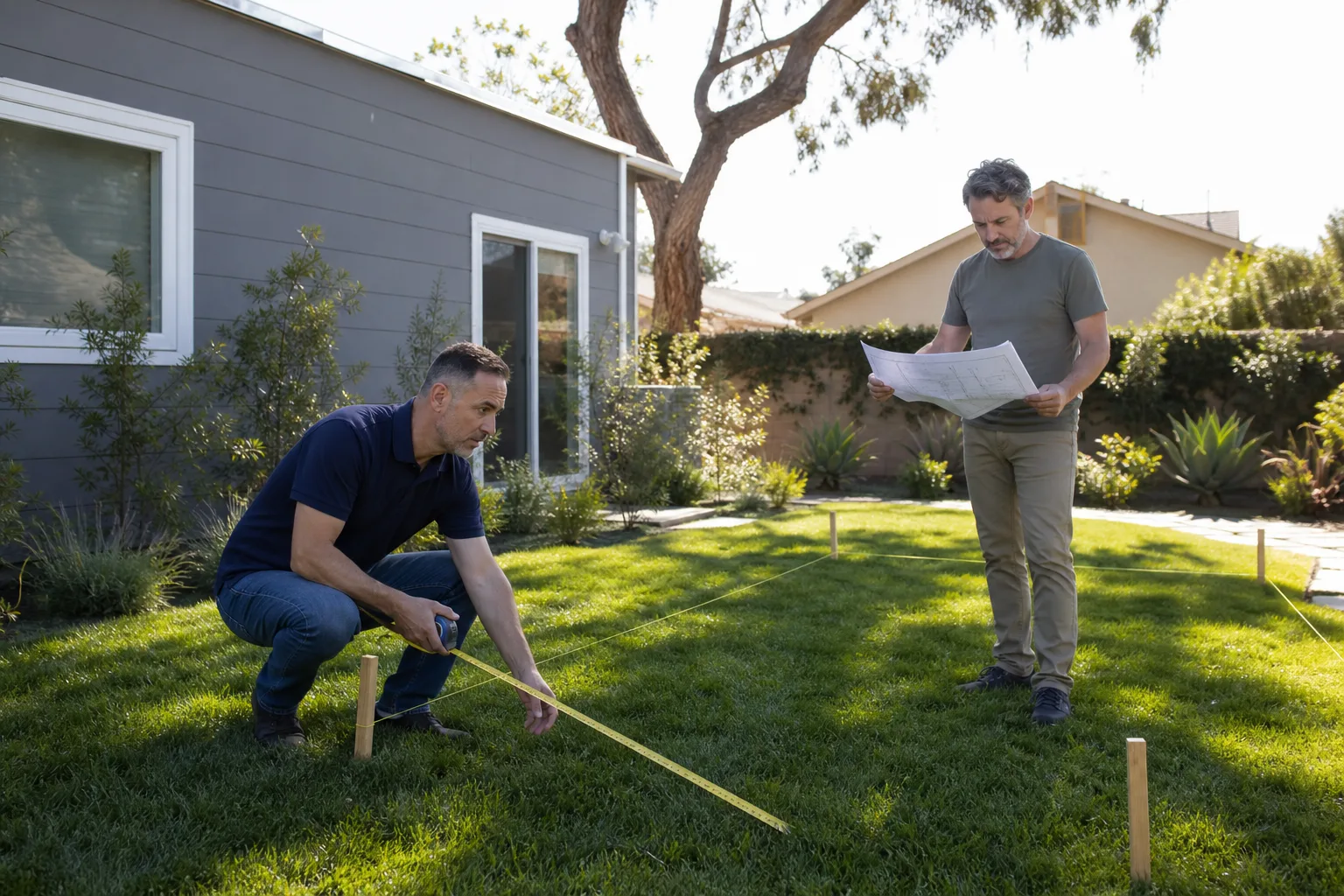
If you’re ready to have a real conversation about building an ADU in the Fort Worth area, our team is ready to talk. We’ll measure your lot, check utility access, review your soil conditions, and hand you a written price. No vague estimates, no disappearing contractors, no surprises. That’s the only way we build.
Pricing reflects the Fort Worth market as of 2026. Benson ADU Fort Worth offers free estimates – call (682) 204-9686.
Written by Troy Eastman, Owner at Benson ADU Fort Worth, serving the Fort Worth area with written-price ADU construction and prefab installations since 2006.
What Our Customers Say
"Communication was the best part. I always knew what was happening that week without having to ask."
- Dolly N."Great build. Inspection delay, the county's fault, pushed things a week, but updates were clear."
- Soo-jin P."Home addition blends in with the original house."
- Vic S.